Is Cash King in a Recession? What 12 Crises Show
Cash wins the panic and loses the recovery. US dollar data from 12 crises: when holding cash paid, when it lost 58% of its value, and whose cash counts.

Cash is king in the first half of a deflationary crisis, especially if it is US dollars, but it is usually the worst asset in the second half, when central banks print money and inflation eats its value. In the 2008 crisis the dollar index rose 24.9% while the S&P 500 fell 57%. Then rates sat at zero for seven years and a dollar held as cash lost 10.7% of its buying power by 2016. Across 1971–82 it lost 58%. Whether cash protects you depends on two questions: is the crisis deflationary or inflationary, and whose currency are you holding?
The numbers below come from PickSkill's crisis cycles page, which tracks cash, gold, housing and stocks through twelve crises since 1929. The links take you to the exact crisis or signal on that page.
Key takeaways
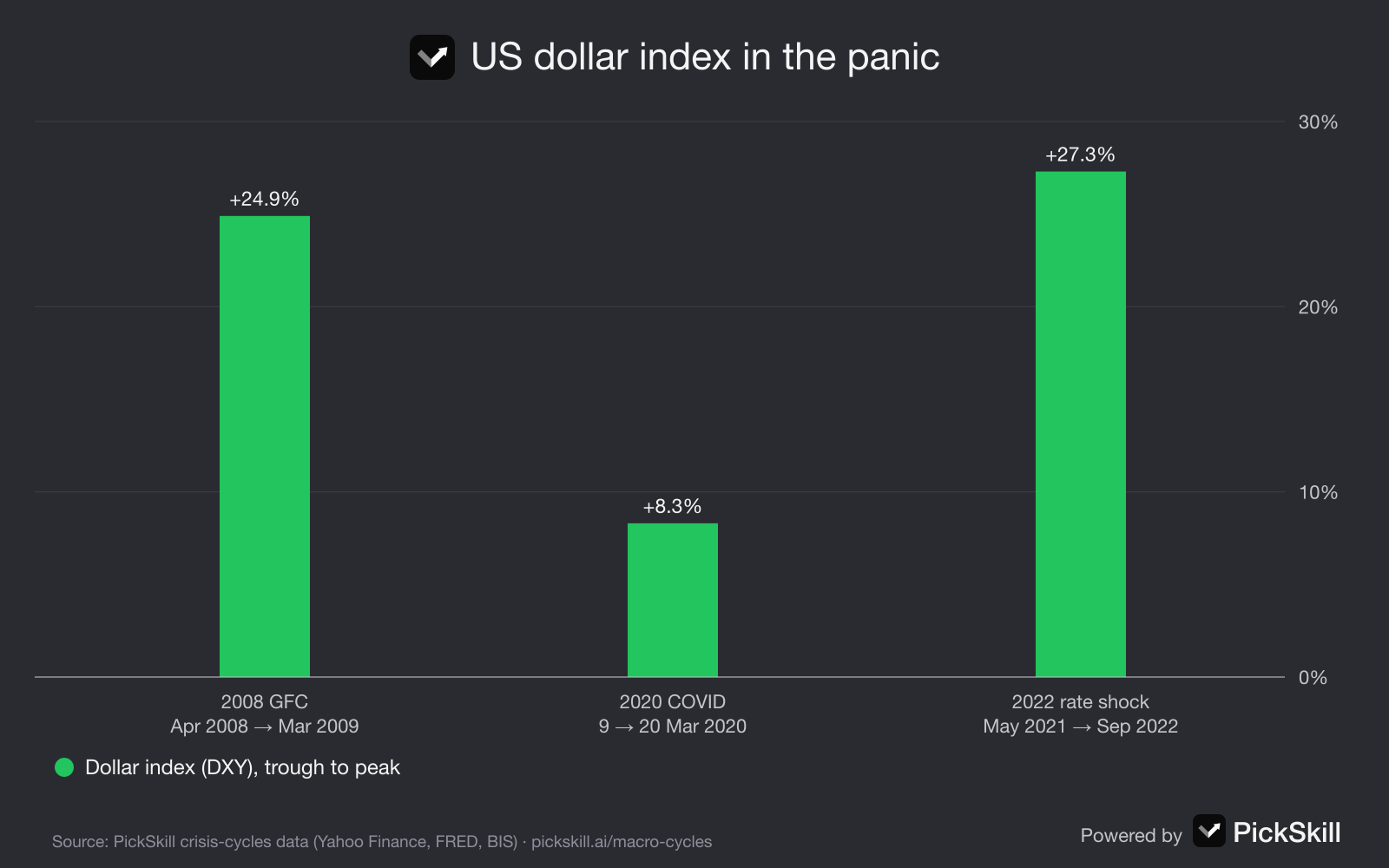
- In the panic, the dollar is the asset everyone wants. The dollar index rose 24.9% in 2008–09, 8.3% in eleven days in March 2020 and 27.3% in 2021–22.
- After the rescue, cash loses. Zero rates and money printing cost a US dollar 10.7% of its real value in 2009–16 and 12.5% in 2020–22.
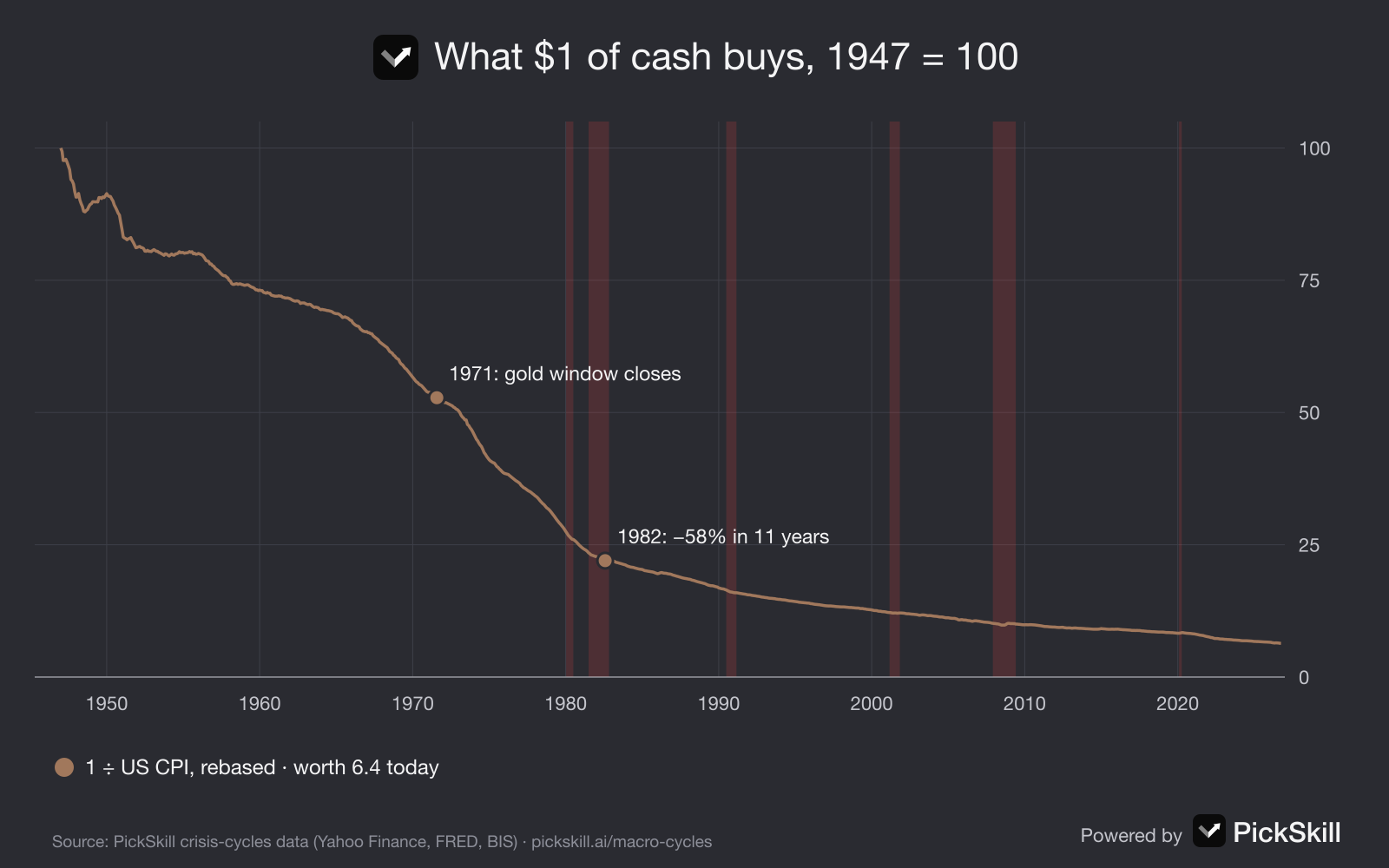
- Inflationary crises are the opposite case. In 1971–82 a dollar held as cash lost 58% of its buying power while gold rose more than tenfold.
- Deflation is where cash really wins. Prices fell about a quarter in 1929–33, and Japanese yen cash beat almost every Japanese asset for two decades after 1990.
- "Cash" means the reserve currency. In 1997 Thai, Korean and Indonesian savers lost half or more of their savings to devaluation.
Why does cash win at the start of a crisis?
Cash wins at the start of a crisis because the first phase is a forced sale of everything else. Banks call in loans, funds face redemptions and leveraged investors get margin calls, so they all sell assets to raise the one thing they owe: money, and in most of the world that means US dollars. Prices of stocks, property, corporate bonds and even gold fall while the dollar rises. PickSkill's playbook calls this the first half of the crisis, and in it cash ranks first of the four assets. The live board tracks it with the dollar squeeze signal: a rise of 6% or more in the dollar index over three months has marked a global dollar shortage. During the 2008 crisis the index went from 71.3 in April 2008 to 89.1 in March 2009, the only major asset that rose through the Lehman collapse.
Why does cash lose after the rescue?
Cash loses after the rescue because the rescue is paid for with new money and near-zero interest rates. Once a central bank goes "whatever it takes", which PickSkill calls the watershed, savers earn almost nothing while prices keep rising. After 2008 the Fed held rates near zero from December 2008 to December 2015, and the real value of a dollar held as cash fell 10.7% between March 2009 and March 2016. After the 2020 crash, US money supply grew about a quarter in a year and inflation reached 9.1%; a dollar lost 12.5% of its buying power between March 2020 and June 2022. Over the same windows gold and stocks recovered strongly. Holding cash through the first half was right. Holding it through the second half was expensive.
Is cash a safe haven when inflation causes the crisis?
No. When the crisis is caused by too much money rather than too little, cash is the worst of the four assets. The 1970s stagflation is the clearest case: between August 1971, when the US closed the gold window, and August 1982 a dollar held as cash lost 58.3% of its purchasing power. Deposit rates lagged inflation for most of the decade. Gold went from $35 to $850 and US home prices more than doubled, while stocks went sideways in nominal terms. Cash only became attractive again when Paul Volcker raised rates to around 20% and real rates turned sharply positive. The 2022 rate shock shows the other side of that coin: once rates rose fast, short-term Treasury bills paid about 5% and cash was the best place to sit while stocks and long bonds fell together.
When is cash really king?
Cash is really king in a debt deflation, when prices fall and every other asset falls with them. In the Great Depression US consumer prices fell about 27% between 1929 and 1933, so cash gained roughly a third in real terms while stocks lost 86% and home prices about a quarter. The catch was that a third of US banks failed, so "cash" had to mean notes or Treasury bills, not deposits. Japan after 1990 is the modern example. With prices flat or falling for two decades and the yen rising from about 160 to 80 per dollar by 1995, yen cash quietly beat Japanese stocks, which fell 80%, and land, which fell for fifteen years. This is the fifth regularity on PickSkill's page: whether cash is king depends on deflation versus inflation.
Does it matter which currency your cash is in?
Yes, and in an emerging-market crisis it matters more than anything else. In the 1997 Asian financial crisis the Thai baht, Korean won and Indonesian rupiah lost between half and four-fifths of their value against the dollar. Savers in those currencies were wiped out even though they held "cash", while anyone holding dollars was protected. During the euro debt crisis money fled from deposits in Greece, Spain and Italy into Swiss francs and German and US accounts, and the franc rose about 30% before the Swiss National Bank capped it in September 2011. A crisis is when the gap between reserve currencies and everything else is widest.
How do you know which phase you are in?
You can check the phase with PickSkill's live signal board, which reads eleven indicators against the thresholds that marked past turning points. For cash the useful lights are the dollar squeeze, the Fed rate cycle and the Fed balance sheet: a surging dollar says cash is winning, a balance sheet growing 5% in three months says the rescue has started and cash is about to lose. To see how this plays out for gold, read does gold go up in a financial crisis. To test your own allocation, ask PickSkill's AI analyst how your holdings fared in each phase of 2008 and 2020.
FAQ
Is cash king in a recession? In the panic phase of a deflationary recession, yes: cash, especially US dollars, has held its value while stocks, property and even gold fell. Once central banks cut rates to zero and print money, cash loses real value, so holding it through the recovery has been costly.
How much did the US dollar rise in 2008? The dollar index rose 24.9%, from 71.3 in April 2008 to 89.1 in March 2009, as banks and funds around the world scrambled for dollars. It was one of the few assets that rose through the Lehman collapse.
How much value did cash lose in the 1970s? A US dollar held as cash lost 58.3% of its purchasing power between August 1971 and August 1982. Inflation peaked at 14.8% in 1980 and deposit rates stayed below inflation for most of the decade.
Is it safe to hold cash in a weak currency during a crisis? Often not. In 1997 the Thai baht, Korean won and Indonesian rupiah lost half to four-fifths of their value against the dollar, so local cash savings were devalued. In a crisis the reserve currency rises and weaker currencies fall.
When should you move out of cash after a crisis? Historically the signal has been a central bank going all in: rates near zero plus large-scale money printing. Gold and stocks have usually bottomed within weeks to months of that point, while cash then lost purchasing power for years.