AI for Stock Research in 2026 — What Actually Works (and What Doesn't)
A build-in-public category map of AI in equity research today. Five categories — three solved, two still working with editorial input.
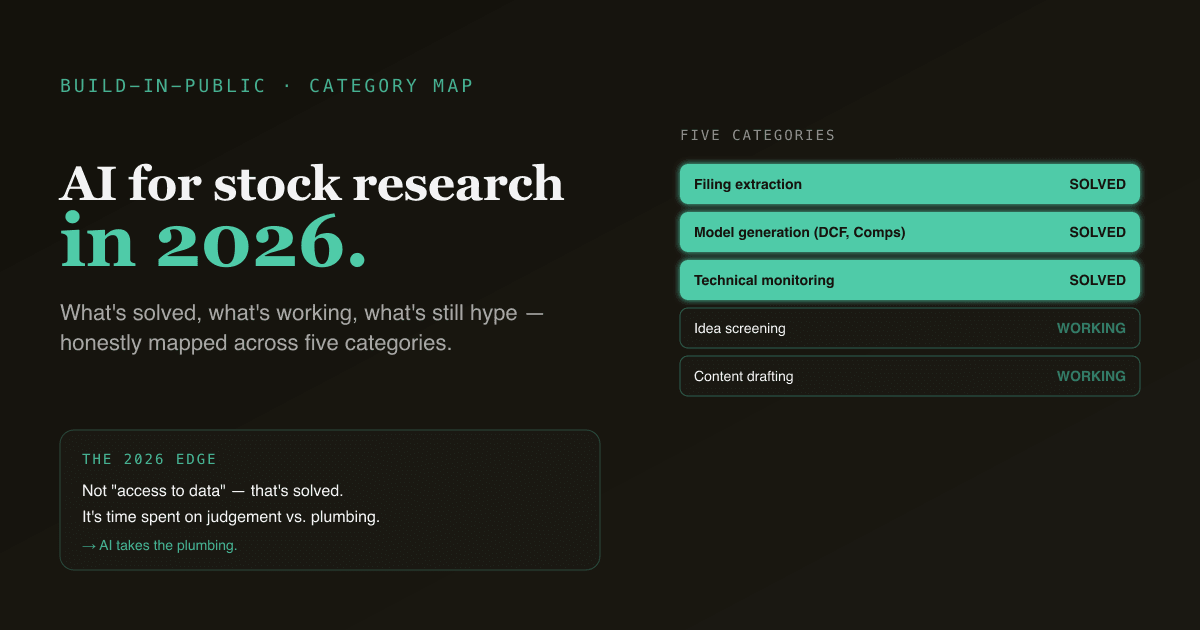
The 2024 wave of "AI for finance" pitches has settled. Some categories of AI use in equity research are now table-stakes (filing summarisation, data extraction); some are working but more narrowly than the demos suggested (auto-generated investment theses); some are still hype (full autonomous portfolio management); and some new categories have emerged that weren't on the 2024 roadmap (live-data agentic chat, on-demand model generation). This post maps where AI is actually being used in retail and professional equity research in 2026, where the leverage is real, where it's overrated, and how PickSkill fits in.
Key takeaways
- Five categories of AI use dominate equity research today: filing extraction, model generation, idea screening, technical-signal monitoring, and content drafting.
- Three of the five have crossed the threshold from "demo" to "actually saves time": filing extraction, model generation, technical monitoring.
- Two are still mid-cycle: idea screening (works but needs editorial input) and content drafting (works for first drafts, not finals).
- The biggest 2024-vs-2026 shift: from "give the AI a 10-K and ask it to summarise" to "give the AI access to live filings, prices, peer data, and let it run a workflow". Tool-using agents that pull live data are what unlocks the 60-second DCF, the 30-second filing summary, and the multi-position indicator dashboard.
- The retail edge in 2026 is no longer "having access to data" — that's solved. It's time spent on judgement vs. plumbing. AI takes the plumbing.
The 2026 map: five categories
| Category | What it does | Where we are | Leverage |
|---|---|---|---|
| Filing extraction | Pull MD&A, financials, Risk Factors from 10-K / 10-Q / proxy / 8-K | Solved | ★★★ |
| Model generation | Build DCF, Comps tables, sensitivity analysis from prompts | Solved | ★★★ |
| Technical monitoring | MACD / KDJ / divergence dashboards across portfolios | Solved | ★★★ |
| Idea screening | Surface names matching multi-criteria thesis (e.g. "FCF yield > 5% and growing revenue > 15%") | Working with editorial input | ★★ |
| Content drafting | Investment notes, theses, board memos | Works for first drafts, finals need humans | ★★ |
Filing extraction — solved
What was "summarise this 10-K" in 2024 is now "extract Items 7, 8, 1A; diff Item 1A vs. last year; flag the 2–3 footnotes that contain material new disclosures; link every claim to the source page." See How to Summarise a 10-K in 60 Seconds. Every modern AI tool in this space does this; the differentiation is now on link accuracy, diff quality, and how cleanly the tool handles 500-page conglomerate filings.
Model generation — solved
A working DCF on any US-listed name in 60 seconds is now table-stakes. The differentiation is: sourced inputs (not hallucinated), live data refresh (10-Y Treasury, Damodaran ERP), editable assumptions (not a black-box output), and Excel-real (formulas link between sheets, not a snapshot PDF). See Build a DCF in 60 Seconds.
Technical monitoring — solved
The MACD/KDJ/divergence dashboards across multi-name portfolios that were custom Python work in 2023 are now one-prompt operations. See Track a Portfolio with Indicators. Where this still falls short: intraday signals, options-overlay analytics, and any signal that requires order-flow microstructure data.
Idea screening — working
"Find S&P 500 names with FCF yield > 5%, revenue growth > 15% YoY, and trading below 5-year median P/E" is now a one-prompt screen. What doesn't work yet: AI-generated theses that come out of the screen. The screen gives you 8 names; deciding which to research and why still benefits from a human-set thesis and editorial judgement on screen criteria (which is the part most AI demos elide).
Content drafting — works for first drafts
The 2024 demo of "AI writes your investment note" has become real for the first draft — headline + bullets + supporting data + risks. The second-pass edit — tightening claims, adding the analyst's specific view, removing AI-cliché phrasing — is still human work. The honest 2026 framing: AI takes you from blank page to first draft in 5 minutes; you spend the next 30 making it good.
What changed between 2024 and 2026
Three shifts:
- Tool-using agents replaced single-shot chat. A 2024 chat that "knows what a 10-K is" is much weaker than a 2026 agent that fetches the actual 10-K from EDGAR, parses it, computes derived metrics, and links the result to the source page. The agent-loop is the unlock — see PickSkill's chunked agent runtime for how the workflow stitches together.
- Sourced output became table-stakes. Hallucinated numbers were tolerated in 2024 because the alternative was no AI at all. By 2026, any production research tool that doesn't link every number to its source filing is below the bar.
- Multi-market coverage went from nice-to-have to expected. US-only was the 2024 default; in 2026 retail investors expect HK + A-share support natively (different filing systems, different indicator conventions like KDJ being more popular in A-shares, different trading hours).
What still doesn't work
Honest about the gaps:
- Full autonomous portfolio management. Letting AI place orders based on its own theses remains experimental. The reliable use-case is AI as a research and monitoring assistant; humans still close the loop.
- Alpha generation from public-data alone. AI levels the playing field on processing speed; it doesn't manufacture edge where the underlying data is fully public. The retail edge stays where it always was: holding good companies for a long time, with discipline, and avoiding the obvious mistakes.
- Forensic accounting. Finding aggressive revenue recognition or one-off-driven margin expansion still requires expert-level pattern recognition the current generation of AI can flag but not conclusively diagnose.
- Macro forecasting. AI is roughly as bad at predicting CPI prints as humans.
Where PickSkill fits
PickSkill targets the three solved categories (filing extraction, model generation, technical monitoring) for the retail and semi-pro audience, with three deliberate choices:
- Sourced or it didn't happen. Every number in a DCF, every claim in a 10-K summary, links back to a primary source — no third-party data middleman, no hallucinated figures.
- Editable, not black-box. Every assumption in a generated model is overrideable in the chat. The point isn't "AI decides your assumptions"; the point is "AI removes the plumbing so you can spend time on assumptions".
- Multi-market by default. US, Hong Kong, and A-share tickers all work with the same prompt patterns. The retail edge in 2026 is workflow speed; that doesn't stop at one market.
What we're working on next
A few items in the public roadmap:
- Quarterly thesis refresh — for users tracking specific positions, automated quarterly check-ins that diff your thesis against the latest filing.
- Earnings-call transcript extraction — Q&A section is where the highest-signal forward-looking commentary lives; current AI tools mostly summarise the prepared remarks.
- Cross-market comparison — running the same Comps analysis on a Chinese chip company against US peers, with explicit mapping for accounting differences.
If you have a specific workflow gap you want to see solved, tell us — the roadmap is responsive to what users actually need.
FAQ
Is AI going to replace human equity analysts? Probably not entirely. Where AI clearly replaces analysts: the plumbing tasks (filing reading, model assembly, data extraction). Where it doesn't: the judgement on which assumptions to make, which risks matter, which businesses are worth holding for a decade. The honest 2026 framing is that AI removes 60–80% of the analyst-task time, leaving the remaining 20–40% — the judgement part — to humans.
Should I trust an AI-generated investment thesis? No more than you'd trust any first draft from a junior analyst. AI is excellent at structuring the analysis, pulling the right data, and writing the first pass. It's not yet good at noticing the one detail that matters most — the kind of edge that comes from having held similar positions before. Treat AI theses as starting points, not finished products.
What AI tools are people actually using in equity research? General-purpose chat (ChatGPT, Claude, Gemini) for first-pass reading and drafting. Specialised tools like PickSkill for sourced model generation, filing diffing, and portfolio monitoring. Excel + Python notebooks for custom analyses the agent layer can't handle yet.
Will PickSkill be available outside US/HK/A-share? Yes, the next markets in the roadmap are Japan (Tokyo Stock Exchange) and India (NSE/BSE), with the same sourced-input, editable-assumption framework. Each market addition is a 2–3 month integration to get the regulatory-filing extractor right.
How is this post different from a marketing piece? We tried — we explicitly flagged what doesn't work (forensic accounting, macro, autonomous trading), and we positioned PickSkill against the solved-not-everything reality. The honest framing is more useful than the heroic one.