How to Research a New Stock in 15 Minutes with PickSkill
A complete first-pass stock research workflow — business model, financials, valuation, technical setup, and risks — in 15 minutes with the chat and indicator tools.
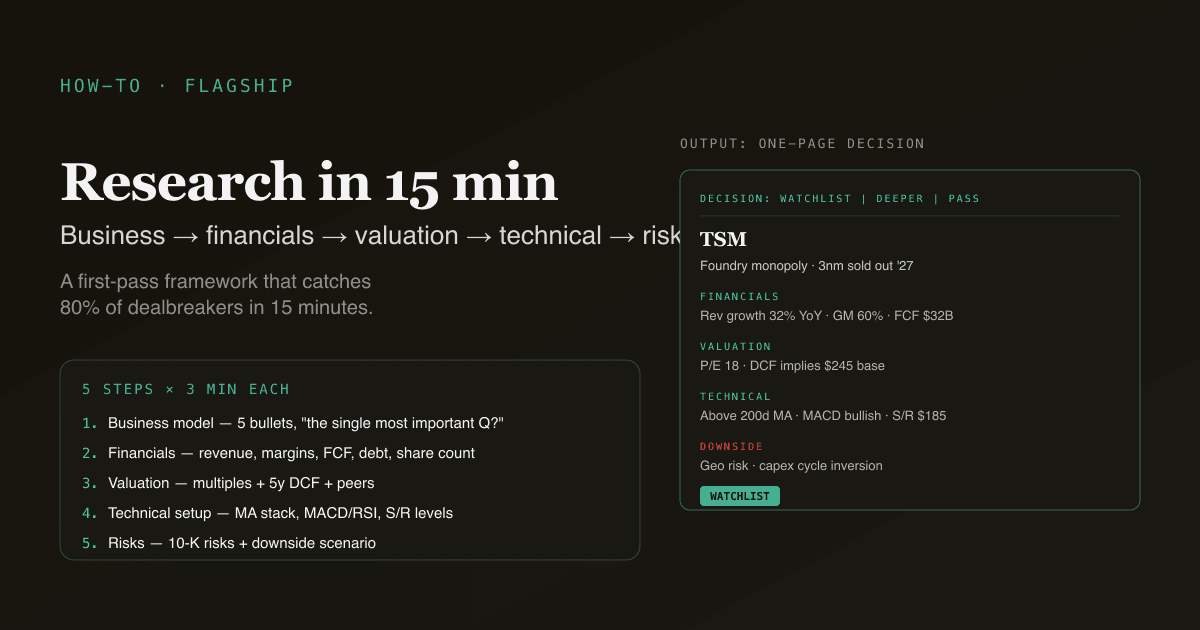
A first-pass stock research session that used to take 2–3 hours can be completed in 15 minutes with the right workflow. Not because you skip steps — the framework still covers business model, financials, valuation, technical setup, and risks — but because PickSkill compresses the data-gathering step into seconds and leaves you with the 15 minutes you actually need: the judgement calls. This tutorial is the canonical first-pass workflow. Use it for any new name you are considering, before deciding whether to add to a watchlist or commit further research time.
Key takeaways
- 5 steps, ~15 minutes total. Business → financials → valuation → technical → risks. Each step is one prompt.
- The framework forces structured thinking — no skipping to "should I buy this?" before answering the upstream questions.
- Outputs a one-page summary suitable for adding to a watchlist or rejecting the name.
- The fast version (15 minutes) catches 80% of dealbreakers. The slow version (2+ hours of deep work) is needed only after the fast version says "interesting."
- Works on US, HK, and A-share names with the same workflow — PickSkill pulls market-appropriate filings.
Why this matters
Most retail investors stumble at the first-pass research stage. Two common failures:
- Skipping straight to the chart. "The chart looks good" is not a thesis. Without the underlying business model and financials check, you are buying a price pattern.
- Drowning in detail. Reading the full 10-K, 8-K, latest earnings call transcript, and every analyst report before deciding if a name is even worth deeper work. By the time you finish, you have spent 4 hours on a name you would have rejected at hour one with a structured framework.
The 15-minute first-pass workflow is the rejection filter. Most names you research will not pass it. The point is to spend 15 minutes per name and reserve the 2-hour deep dive for the names that pass.
The 5-step workflow
Step 1 — Business model (3 minutes)
Open /chat. Paste this prompt:
Summarize [TICKER] in 5 bullets:
1. What does the company actually do (1 sentence)
2. Revenue split — top 3 segments and their % of total
3. Top 3 customers or customer concentration
4. Top 3 competitors
5. The single most important question this business needs to get right
PickSkill returns a concise business-model summary built from the latest 10-K and recent press releases. The "single most important question" framing forces clarity on what actually drives the business — a useful test of whether you understand the company or just the ticker.
Red flags at this stage: business model not clear after 5 bullets, customer concentration above 30% on a single customer, no visible competitive moat. Stop here if you see these; the name is not worth the next 12 minutes.
Step 2 — Financials health (3 minutes)
Next prompt:
For [TICKER], pull the last 4 quarters and last 3 years of:
- Revenue and revenue growth YoY
- Gross margin trajectory
- Operating margin trajectory
- Free cash flow (last 4 quarters)
- Net debt position (cash − total debt)
- Share count change YoY (buybacks vs issuance)
PickSkill renders this as a small table. The financial story should be coherent in one minute of reading.
Red flags at this stage: revenue growth decelerating sharply, margins compressing without a clear cause, negative free cash flow that is not from intentional growth investment, share count rising 5%+ annually without acquisition activity.
Step 3 — Valuation snapshot (3 minutes)
Next prompt:
For [TICKER], compute:
- Current trailing P/E, forward P/E, EV/EBITDA, P/B
- 5-year historical range for each multiple (10th–90th percentile)
- Where current multiples sit within that historical range
- Compare current multiples to 3 closest peers
- Quick 5-year DCF — implied price at base assumptions
PickSkill returns the multiples, peer comparison, and a quick DCF (see Build a DCF in 60 Seconds for the full version).
Red flags at this stage: every multiple at the top of its 5-year range with no clear acceleration in fundamentals to justify; DCF implied price more than 30% below current; relative valuation higher than every peer.
Step 4 — Technical setup (3 minutes)
Next prompt:
For [TICKER], show me the current technical setup:
- Price vs 20 / 60 / 200-day MA
- Current MACD, RSI, KDJ readings
- Any active divergence (regular or hidden)
- Nearest support and resistance levels
- 5-day bucket trail across the full indicator suite
PickSkill pulls the /indicators data and surfaces the multi-signal alignment.
Red flags at this stage: deeply overbought entry (RSI > 75, every indicator pinned high), bearish divergence forming, price extended far above the 200-day SMA. These are not buy-it-now setups; they are wait-for-pullback names.
Step 5 — Risks (3 minutes)
Final prompt:
For [TICKER], list:
- Top 3 risks from the latest 10-K's risk factors section
- Top 3 risks from recent earnings calls (last 4 quarters)
- One downside scenario — what does this stock look like if the bull case is wrong?
PickSkill summarizes the 10-K risk factors and recent management commentary. The downside-scenario question is the one most retail readers skip — and the one that catches the most expensive mistakes.
Red flags at this stage: management's stated risks include single-customer concentration, regulatory overhang, balance sheet stress, or any "going concern" language. These are not automatic disqualifiers but they should reframe the position-sizing conversation.
How to compile the output
After step 5, ask:
Compile this conversation into a one-page summary I can save:
- Business model in 2 sentences
- Financials trajectory in 4 bullets
- Valuation summary with 3-line bull/base/bear
- Technical setup status
- Top 3 risks
- Decision: watchlist, deeper research, or pass
PickSkill returns a structured one-pager. Save it via the chat session bookmark. If you decide to put the name on the watchlist, the one-pager becomes your thesis document.
Try it now. Open /chat and run the 5 prompts above on a name you are considering. The whole loop is ~15 minutes including reading time.
What the workflow catches that ad-hoc research misses
1. Structural rejection vs price-driven rejection
Ad-hoc research often rejects names based on chart appearance ("looks overbought") without checking whether the business is even worth owning at any price. The structured workflow flips the order: business → financials → valuation → technical. If the business or financials fail, the chart doesn't matter; if business and financials pass, the chart tells you about timing, not viability.
2. The downside scenario question
The single most-skipped step in retail research is "what does the bear case look like?" The structured workflow forces it. Without it, you over-weight the bull case and under-prepare for the variance.
3. Multi-source synthesis in one place
The workflow pulls 10-K data, recent earnings, current multiples, peer comparison, and technical state into one chat session. Each piece would take 10–20 minutes to gather manually — PickSkill compresses each to seconds, leaving time for the actual thinking.
Four pitfalls in stock research
- Skipping the business-model step. Knowing a stock's ticker is not knowing the company. Without the 5-bullet summary, you are trading a ticker, not researching a business.
- Ignoring the downside scenario. Bull cases sell themselves; bear cases need to be deliberately surfaced. If you cannot articulate the bear case, you have not done the research.
- Treating "everything green" as a buy. A stock with strong fundamentals, attractive valuation, and good technicals is not automatically a buy — sometimes it is a name where the easy money has been made and the next 12 months are flat. Position sizing and entry-level discipline matter.
- Not committing the output to a watchlist or rejection. The whole point of the 15-minute first-pass is decision-making at the end. "Need to think about it" is the killer — it consumes mental bandwidth without producing a decision. Force yourself to land on watchlist, deeper research, or pass.
How this applies on A-shares
The workflow works identically on A-share and HK names. Two specific adjustments:
- For A-shares, the "扣非净利润" (net income excluding non-recurring) is the relevant earnings number; PickSkill defaults to this when computing A-share P/E and EPS growth.
- A-share valuation multiples are structurally lower than US peers for most sectors. Compare to the A-share historical range, not the US equivalent.
See Best Indicators for A-shares for the broader market-specific playbook.
Common follow-up prompts
After the 15-minute first-pass:
- "Deeper DCF on [ticker] — full sensitivity table, segment-level revenue projection."
- "Compare [ticker] to its 3 closest peers on the full multiple stack and FCF growth."
- "Generate an investor deck for [ticker] from this conversation." (See Generate an Investor Deck from a Chat.)
- "Add [ticker] to my watchlist with this thesis: [...]"
- "Schedule a re-review of [ticker] for the next earnings release."
Further reading
- Build a DCF in 60 Seconds — the valuation deep-dive when the 15-minute first-pass passes.
- How to Read a 10-K in 30 Minutes — the manual deep-read version of step 1 + step 2.
- How to Build a Watchlist That Actually Works — where successful first-pass names go next.
FAQ
Why 15 minutes — isn't that too fast for a stock? For a first-pass yes/no decision, 15 minutes is more than enough — most names should be rejected at this stage. The deep work (modelling specific assumptions, reading every recent SEC filing, talking to ex-employees) is reserved for the small subset of names that survive the first-pass. Spending 4 hours on every name you encounter is the dominant failure mode of motivated retail investors.
Can I research multiple names in parallel? Yes — PickSkill supports parallel chat sessions. Many users open 3–5 sessions simultaneously and run the same 5-prompt template on each. The structure makes batch research practical.
What if PickSkill doesn't have data on the name? PickSkill covers most US-listed (NYSE / NASDAQ), HK-listed (HKEx), and A-share-listed (SSE / SZSE) names. For very small or recently-listed names, coverage may be thinner — PickSkill will tell you which data points are unavailable rather than fabricating.
Should I save the chat sessions? Yes — every chat session in PickSkill is persistent. Bookmark useful research sessions for later reference. When you decide to take a position, the chat session is the audit trail of how you arrived at the thesis.
How does this differ from generic ChatGPT research? PickSkill's chat is grounded in live filings, market data, and computed indicators — not in the model's training data. ChatGPT will hallucinate revenue figures and P/E ratios; PickSkill pulls them from primary sources at query time. The structural difference matters most for the financial and valuation steps, where stale or fabricated numbers can completely change the conclusion.