How to Build a Watchlist That Actually Works (Not a Dumping Ground)
A focused 8–15 name watchlist with thesis, levels, and review cadence beats a 50-name dumping ground every time. Step-by-step setup in PickSkill.
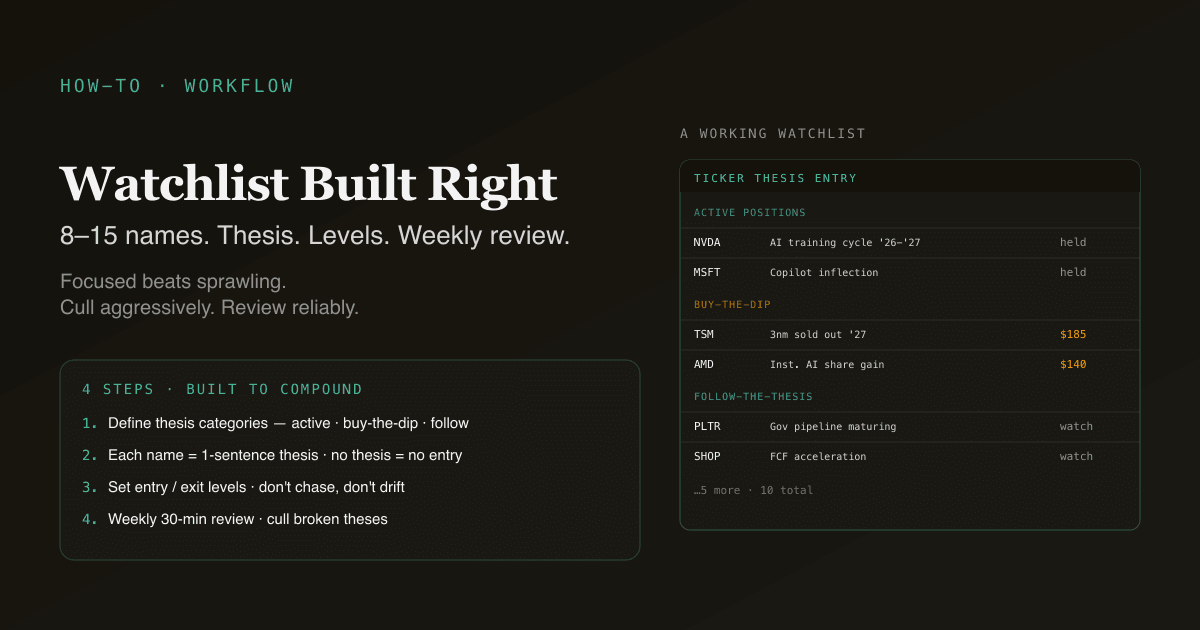
Most investor watchlists are dumping grounds — 40+ tickers with no structure, no thesis on why each one is there, and no cadence for reviewing them. A focused 8–15 name watchlist with one-sentence thesis per name, defined entry levels, and a weekly review cadence beats a 50-name dumping ground every time. This tutorial walks through the watchlist setup that actually compounds — the same setup the PickSkill platform is designed to support — and the discipline to keep it useful three months from now.
Key takeaways
- 8–15 names is the right size. Smaller than 8 = thin opportunity set; larger than 15 = nothing gets attention. The cognitive limit on names you can actually track is single digits, not double.
- Every name needs a one-sentence thesis. "Why is this on my watchlist?" Three categories: own-it-watch (active position), buy-the-dip (waiting for entry), follow-the-thesis (track but won't trade soon).
- Every name needs an entry level. Without a defined "act-on price," you will either chase strength or never act.
- Weekly review cadence — 30 minutes once a week — is enough to keep the list relevant. Daily review is overkill; monthly is too slow.
- Cull aggressively. Names that don't fit the thesis 90 days later should be removed, not "kept just in case."
Why most watchlists fail
Three common failure modes:
- The dumping ground: Anything interesting goes on the list. Six months later, it's 40+ names and the watchlist is a noise generator, not a focusing tool.
- The forgotten list: Created during enthusiastic research phases, then never reviewed. Names sit on the list with stale thesis, missed catalysts, and outdated entry levels.
- The over-reviewed list: Checked daily, traded reactively, with no time for the underlying thesis to play out. Watchlist becomes a high-turnover gambling list.
The fix is structural: a fixed-size list, a thesis discipline, a clear review cadence, and aggressive culling.
The 4-step setup
Step 1 — Define your thesis categories
Three buckets cover almost all watchlist use cases:
| Category | Description | Typical size |
|---|---|---|
| Active positions | Names you currently own | 5–10 (matches typical portfolio) |
| Buy-the-dip | Names you want to own at a specific entry level | 3–5 |
| Follow-the-thesis | Names tracking an investment thesis (long-term watch, not near-term action) | 2–5 |
Total: 10–20 names depending on your activity level. If your number drifts above 20, the discipline is to cull — not to expand.
Step 2 — Add each name with a one-sentence thesis
Go to /portfolios and create a watchlist portfolio for each category (or one portfolio with notes per holding). For each name, write a one-sentence thesis:
NVDA — Active position. AI training spend cycle 2026-2027; trim if forward
       margin compresses below 70%.

TSM — Buy-the-dip. 3nm capacity sold out through 2027; entry at $185
      (pullback to 50-day MA).

PLTR — Follow-the-thesis. Government contract pipeline maturing; not
       trading yet, watching for clarity on 2027 commercial revenue.
If you cannot write a one-sentence thesis, the name does not belong on the watchlist. Either do the research to form one, or move on.
Step 3 — Set entry / exit levels per name
For each buy-the-dip name, define the entry level:
TSM — Entry $185 (pullback to 50-day MA + nearest support level)
For each active position, define the exit conditions:
NVDA — Trim 25% if forward gross margin compresses below 70% for 2 quarters
      Trim 50% if a major customer signals capex cut
      Exit if the AI thesis breaks (broad evidence of compute oversupply)
The PickSkill dashboards surface the current price and the nearest support/resistance levels per holding — pair these with your defined entry / exit thresholds to see which names are near actionable.
Step 4 — Set up the weekly review
Pick one day per week (Sunday evening works for most retail). Spend 30 minutes:
- Scan the /indicators dashboard for any holdings showing fresh signal changes (new oversold readings, divergence flags, golden crosses).
- Review buy-the-dip names against current price. Any near entry levels?
- Re-read each thesis — does it still hold? If a thesis has materially broken, cull the name.
- Note any new candidates to add. Be selective — every addition forces a cull elsewhere.
The 30-minute weekly cadence is the discipline most retail investors skip. It is the difference between a watchlist that compounds insight and one that fossilizes.
Try it now. Open /portfolios and create a "Watchlist" portfolio. Add 8–10 names with one-sentence theses in the description field. Run the /indicators dashboard on it. The weekly review takes 30 minutes once you have the structure.
How to use PickSkill features to support the workflow
| Discipline | PickSkill feature |
|---|---|
| Defined entry levels | Support/resistance dashboard — see how close each name is to its entry level |
| Thesis tracking | Per-holding notes; /chat sessions per name for deeper research |
| Signal alerts | /indicators dashboard with 5-day bucket trail across MACD, RSI, KDJ, divergence |
| Cull triggers | Quarterly earnings review via chat-to-deck |
| Sharing for second opinions | Share portfolio via link for a friend to review |
The point of a watchlist is to focus your attention. The product features above are designed for that focus, not for surface area.
Four pitfalls retail readers fall into
- Letting the list expand indefinitely. Each new name dilutes attention on existing names. Hard-cap at 15 active watchlist names; force a cull for each addition.
- Skipping the thesis sentence. Names without a thesis are unstructured noise. Force every addition to have one.
- No review cadence. Watchlists go stale within 60 days of last touch. A 30-minute weekly review is the minimum maintenance discipline.
- Refusing to cull. Names that have not earned their place after 90 days should be removed. "Maybe later" is not a thesis.
How this fits into a broader investing workflow
The watchlist sits between research and action:
| Stage | Surface | Question answered |
|---|---|---|
| Discovery | News, X / Reddit, screens | What's interesting? |
| Initial research | /chat — DCF, 10-K, comparables | Is this worth deeper work? |
| Watchlist | /portfolios + thesis + levels | Track until actionable |
| Action | Entry / exit decisions, sizing via ATR | When and how much? |
| Review | Weekly indicator check + monthly thesis revisit | Is the thesis intact? |
Names should flow through this pipeline, not pile up at the watchlist stage. The discipline is moving names off the watchlist — into active positions, or off the list entirely — not just adding new ones.
Common follow-up prompts
- "For my watchlist, show me which names are within 5% of their defined entry levels. Sort by proximity."
- "Run the divergence scan on my watchlist. Any names showing multi-oscillator bullish divergence in the last 5 bars?"
- "Generate a one-page weekly review for my watchlist — current price vs entry level, indicator state, thesis intact yes/no."
- "Backtest a rule that buys watchlist names when they hit entry level AND RSI crosses above 30 from below. What's the hit rate?"
Further reading
- Track a Portfolio with Indicators — the upstream tutorial on adding holdings to PickSkill.
- How to Research a New Stock in 15 Minutes — the research workflow that produces watchlist candidates.
FAQ
How many names should I have on my watchlist? 8–15 is the sweet spot. Smaller (3–7) means too few opportunities for the work you put in; larger (20+) means nothing gets real attention. The cognitive limit on how many distinct theses you can hold and update is single digits — that drives the upper bound.
Should my watchlist overlap with my portfolio? Yes — your active holdings should be on the watchlist for indicator tracking and thesis review. The watchlist is bigger than the portfolio by definition (it includes names you don't yet own), but every owned name should be on it.
How often should I review the watchlist? Weekly is the standard cadence. Daily is overkill and breeds reactive trading. Monthly is too slow — by the time a signal arrives, you may have missed the entry. Pick one fixed day per week (Sunday evening or Saturday morning is common) and treat it as non-negotiable.
What's the difference between a watchlist and a portfolio? A portfolio is what you own. A watchlist is what you are tracking. In PickSkill, both surfaces exist under /portfolios — you can have multiple portfolios labeled differently. Many users have an "Active" portfolio (current positions), a "Watchlist" portfolio (tracking but not owned), and a "Research" portfolio (deep research in progress, not yet committed either way).
When should I cull a name from the watchlist? Three triggers: (1) the thesis has broken (the bull case no longer applies), (2) the name has been on the list 90+ days with no near-term path to action, (3) you cannot articulate the thesis in one sentence after a quarterly check. Aggressive culling is what keeps the list useful.