Can AI Pick Stocks? What the 2026 Tests Show
What public tests of ChatGPT, Gemini, DeepSeek and other AI stock picks found, why one model's answer shifts run to run, and a sturdier way to use AI.

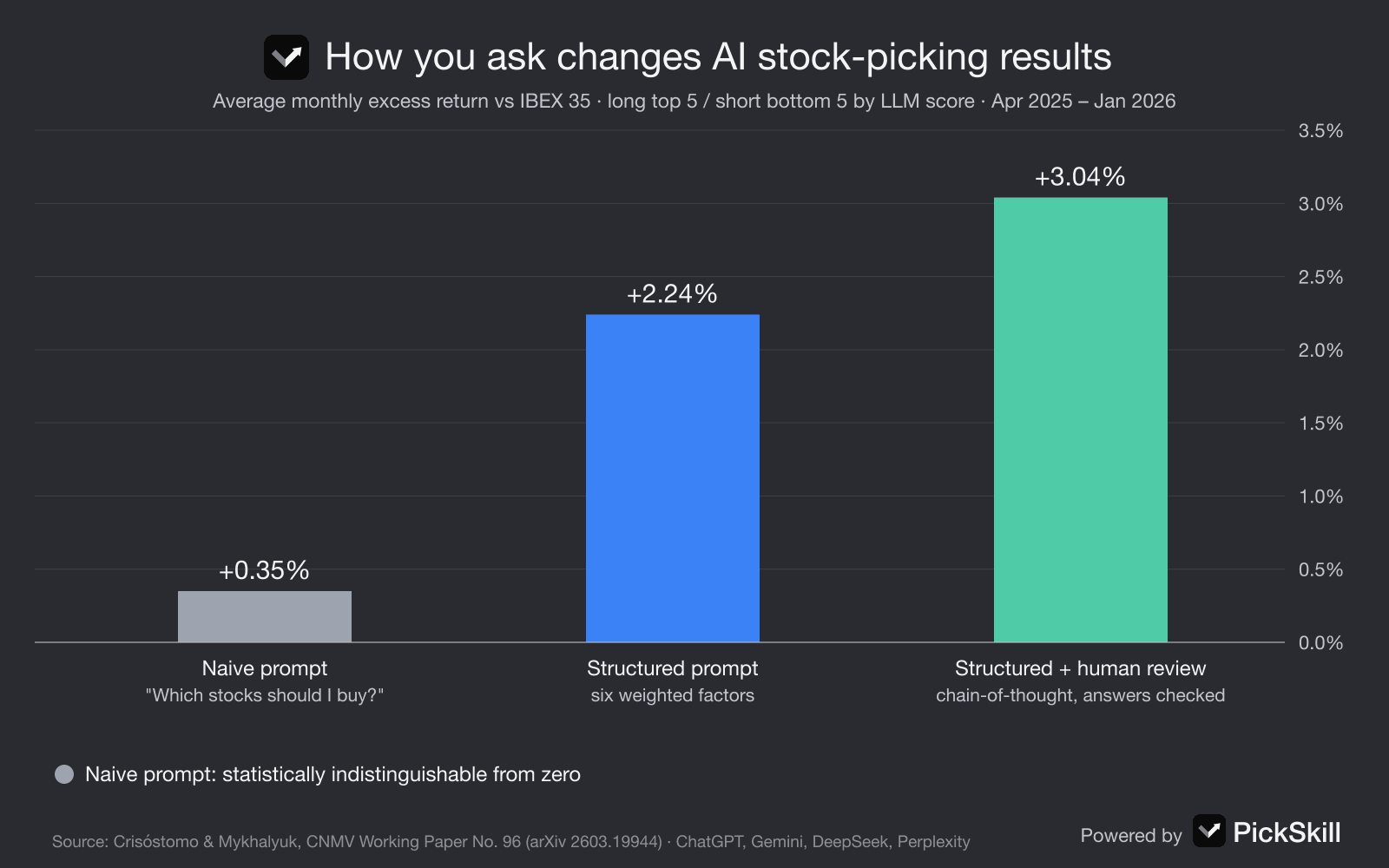
AI can help you research stocks, but the public evidence does not show that a chatbot can reliably pick winners on its own. AI stock picking is asking a large language model (LLM) such as ChatGPT, Gemini or DeepSeek to choose or rank stocks expected to beat the market. In a ten-month live test of IBEX 35 stocks published as CNMV Working Paper No. 96 (March 2026), simple "which stocks should I buy?" prompts produced an average excess return of 0.35% a month, which the authors found statistically indistinguishable from zero.
Results improved sharply once prompts were structured and a human checked the reasoning. Other 2025–2026 tests agree: results are mixed, depend on how you ask, and one model's answer is not stable enough to treat as an oracle.
Key takeaways
- The evidence is mixed. In the four public experiments below, some AI portfolios beat their benchmark and some lagged, often over short windows of six to ten months.
- How you ask matters as much as which model you ask. In the CNMV study, average monthly excess return rose from 0.35% (naive prompt) to 2.24% (structured prompt) and 3.04% (structured plus human review).
- One model, one run is noisy. The CNMV authors list "output instability" (different outputs for identical prompts) as a recurring failure; our own AI Panel gave NVDA a split verdict, then a bearish one, on the same data about 70 minutes apart.
- Models share blind spots. Research finds a tilt toward technology and large-cap stocks, and a Harvard study found ChatGPT more optimistic than DeepSeek on Chinese stocks because of missing negative news.
- Use AI for research and second opinions, compare independent models and read where they disagree.
Can AI actually pick stocks that beat the market?
Not reliably on its own, based on what has been published so far. The most rigorous public test is CNMV Working Paper No. 96, "Large Language Models and Stock Investing: Is the Human Factor Required?" by Ricardo Crisóstomo and Diana Mykhalyuk of Spain's securities regulator. From April 2025 to January 2026, they asked ChatGPT, Gemini, DeepSeek and Perplexity on the first trading day of each month to score all 35 IBEX 35 stocks, then tested a long–short portfolio of the five highest and five lowest scores. Naive prompts earned 0.35% a month in excess return, statistically indistinguishable from zero. Structured prompts with six weighted factors lifted that to 2.24%, and chain-of-thought prompting with human review of each answer reached 3.04%. The authors' conclusion is that LLMs "can outperform the market" when guided and supervised, but that this outperformance is "neither automatic nor robust in autonomous deployments".
What did public AI stock-picking experiments find?
Four public tests from 2025–2026 cover different markets, models and setups, and none is long enough to settle the question. Read together, results swing by model, risk level and time window, and the better results come with more structure or human oversight.
| Who | Models | Market and period | What they found |
|---|---|---|---|
| CNMV Working Paper No. 96 | ChatGPT, Gemini, DeepSeek, Perplexity | IBEX 35, Apr 2025 – Jan 2026, monthly | Naive prompts: 0.35%/month excess (not significant). Structured: 2.24%. Human-supervised: 3.04%, with all four models significant |
| Finder AI Portfolio Showdown | ChatGPT, Gemini, Copilot, DeepSeek, Perplexity, Meta AI, Grok | Four 10-stock portfolios each, Jan – Dec 2026 (results to Oct) | Every aggressive portfolio lost money and trailed both benchmarks; DeepSeek's conservative portfolio led at 15.11% |
| Dezerv | Grok, ChatGPT, Gemini, Perplexity, Claude | Indian stocks vs Nifty 500 TRI, from 4 Aug 2025 (six-month check) | Gemini and Perplexity ahead, Grok and ChatGPT behind, Claude roughly at market; author calls the result likely variance |
| Harvard Business School (Wang, Cao, Xiang) | ChatGPT 4.1, DeepSeek R1 | 4,978 Shanghai and Shenzhen stocks, forecasts for 31 Dec 2024 | ChatGPT forecast prices about 12.5% higher than DeepSeek, with 13% larger absolute errors |
Finder's October 2026 update notes that its test covers "a relatively short timeframe". Dezerv's write-up calls the models "stochastic brainstormers, not disciplined Portfolio Managers" and says skill would need consistent risk-adjusted results across market cycles. The HBS study is a forecasting test rather than a portfolio, but it shows how training data can tilt every answer one way.
Why do AI stock picks change from one run to the next?
LLMs generate answers by sampling, so the same question can come back with a different emphasis, a different stock or a different conclusion. They also search the web differently each time. The CNMV paper's taxonomy of reasoning failures includes "search instability" (dozens of sources in one query, two in a comparable one) and "output instability" (a score of 0.75 that changes in an equivalent prompt), alongside stale data, hallucinated figures, currency mix-ups and arithmetic errors. Dezerv's author makes the same point: the models are non-deterministic and carry no accountability from one month to the next. For an investor, one chat answer is a single sample from a range of possible answers, and nothing in it tells you which one you got.
We saw this in our own data. PickSkill's AI Panel asks five models — DeepSeek V4 Pro, Qwen 3.8 Max, Kimi K3, GLM-5.3 and MiniMax M2.5 — to read the same fact sheet on a stock, then a judge model tallies their views. On 19 November 2026 we ran NVDA twice, about 70 minutes apart, on the same data as of the 17 November close ($155.46). The first run was requested in Chinese and the second in English, and in the first run GLM's view did not come back, so it is not a perfectly controlled test. Still, the result is useful (we break down every model's view in 5 AI Models Analysed NVDA):
- Run 1 (02:21 UTC): Qwen and Kimi bearish, DeepSeek and MiniMax neutral. Tally score −0.55, verdict split. The judge's strategy: a small probe in the 148.35–155.46 support zone with a stop at 148.
- Run 2 (03:31 UTC): GLM, Qwen, MiniMax and DeepSeek bearish, Kimi neutral. Tally score −0.81, verdict bearish. The judge's strategy: avoid new long positions and trim on a bounce toward 162.87.
- What moved: three of the four models that answered both times changed stance. Kimi went from bearish to neutral, while DeepSeek and MiniMax went from neutral to bearish. Only Qwen held its view.
- What held: both runs agreed on the facts that mattered — a strong downtrend, oversold oscillators and support near 148.35 — and both leaned negative.
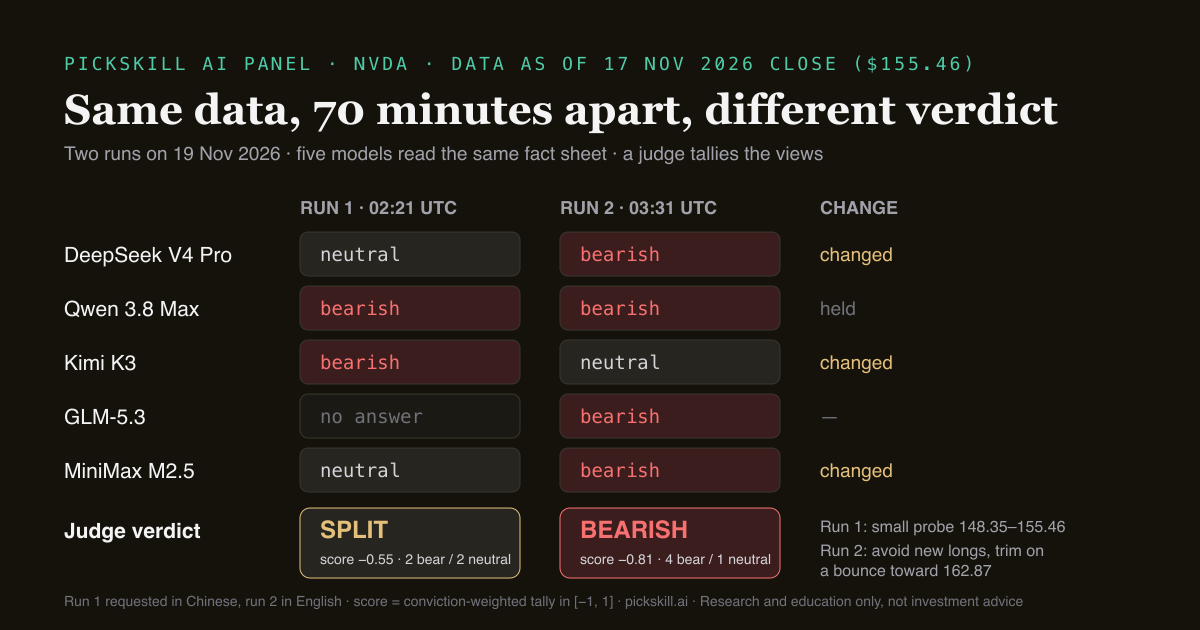
The direction was stable; the conviction and action were not. With only one of those answers you could have walked away with "probe for a bounce" or "avoid" with equal confidence.
Do different AI models just pick the same big stocks?
Often, yes, and that is a risk rather than a confirmation. A study of LLM investment bias by Hoyoung Lee and co-authors (arXiv 2507.20957) reports that "a tendency to prefer technology stocks, large-cap stocks, and contrarian strategies is observed" across most models tested, and that these preferences can harden into confirmation bias. When several chatbots all suggest the same handful of mega-cap names, they may be repeating the same training data and news coverage rather than reaching independent conclusions. In the HBS study, ChatGPT's optimism on Chinese firms disappeared once researchers added Chinese-sourced news, so the bias came from what the model had read. Dezerv's author also warns about many users converging on the same AI picks. Agreement between models is only meaningful when the models are independent and work from the same verified facts.
How should you use AI for stock research instead?
Treat AI as a fast research assistant and a second opinion, not as a stock picker. The CNMV results point to a simple rule: give the model structure, verified data and a clear task, and check its reasoning before you act.
- Ground it in data, not memory. Ask the model to work from a dated fact sheet — price action, signals, valuation, latest earnings — rather than from whatever it remembers. The CNMV study found that official filings improved accuracy.
- Ask for structure. Request a stance, a time horizon, the reasons, the risks and what would change its mind, instead of "is this a buy?". See technical vs fundamental analysis for which inputs belong where.
- Ask more than once, and more than one model. Run the same question through several independent models and look at the spread.
- Read the disagreement first. Where models differ is usually where the real uncertainty sits: a support level, an earnings risk, a valuation call.
- Decide yourself, with your own risk rules. No model knows your time horizon, position size or tax situation.
PickSkill builds steps 1, 3 and 4 into one screen. The AI Panel gives five models the same fact sheet and shows a conviction-weighted tally score from −1 to +1 alongside each model's stance, reasons and risks. Its judge lists the agreements and disagreements and returns one of four verdicts: bullish, bearish, neutral or split. In our 11 panel runs from 17–19 November 2026, the five models were unanimous on only three stocks (GOOGL and META bearish, AAPL neutral). For open-ended questions, the AI analyst chat pulls signals and earnings data into a conversation. Our guide to AI for stock research in 2026 covers the wider set of tools.
What can't AI do for stock picking yet?
AI can't see the future, can't guarantee its data is current, and can't tell you how confident it should be. The public tests are short, six to ten months, on particular markets and model versions that change every few months. The CNMV paper found recurring errors in data retrieval, financial interpretation and arithmetic, which are hardest to catch for the investors most likely to rely on a simple prompt. Our 11 panel runs are far too few to say anything about returns; they only show how the answers behave. Use AI to widen what you check, not to skip the checking. This article is for research and education only, not investment advice.
FAQ
Is ChatGPT good at picking stocks? The public evidence is mixed. In CNMV Working Paper No. 96, ChatGPT's simple conversational prompts produced negative excess returns on IBEX 35 stocks, while structured and human-supervised prompts did much better. In Finder's 2026 showdown its aggressive portfolio was down 13.09% by October 2026. ChatGPT is more useful for explaining filings and structuring research than for choosing stocks unaided.
Has any AI beaten the stock market? Some AI portfolios have beaten their benchmarks over short periods. In the CNMV study, all four models produced statistically significant excess returns, but only with structured prompts plus human review of every answer. Finder's conservative AI portfolios mostly beat their benchmarks through October 2026, while every aggressive one trailed. None of these tests is long enough to prove lasting skill.
Why does AI give different stock picks each time I ask? Language models sample their answers and search the web differently on each request, so identical prompts can return different stocks, scores or stances. The CNMV paper lists this "output instability" as a recurring failure. PickSkill's AI Panel moved NVDA from a split verdict to a bearish one on the same data about 70 minutes apart.
Is it better to ask several AI models instead of one? Asking several independent models, all reading the same verified data, is sturdier than trusting one answer, because you can see whether they agree and where they don't. Agreement is weak evidence when models share the same training biases, such as a tilt toward large-cap tech, so read the disagreements and the stated risks before you decide.
Can AI replace a financial adviser or my own research? No. AI can speed up research, summarise filings and offer a second opinion, but it does not know your goals, time horizon or risk tolerance, and it makes errors with data and arithmetic. HBS professor Charles Wang put it this way: AI tools "can accelerate research, but they're not a replacement for human judgment".