DeepSeek vs Qwen vs Kimi for Stock Analysis
DeepSeek, Qwen, Kimi, GLM and MiniMax read the same fact sheet for 11 stocks. How their stances, conviction and dissent differed, with the method.

There is no "best" AI model for stock analysis yet in our data, but there are clear differences in behaviour: given the same fact sheet, DeepSeek V4 Pro was the most decisive, Qwen 3.8 Max the most cautious, and Kimi K3 the most likely to break from the pack. A DeepSeek vs Qwen vs Kimi comparison is a test of how each large language model (LLM) turns identical market data into a stance, a conviction score and a plan. Across 11 PickSkill AI Panel runs on 17–19 Nov 2026 data, DeepSeek averaged a conviction of 3.36 out of 5 and never made a bullish call; Qwen averaged 2.60 and never went above 3.
This is a behaviour comparison, not an accuracy ranking. The runs are days old, so no outcomes exist to score yet, and 11 runs (53 model views) is a small sample. What the data can show is how the models differ when nothing else differs.
Key takeaways
- Same input, different temperaments. All five models read one fact sheet per run. DeepSeek V4 Pro called 7 of 11 runs bearish and 0 bullish; MiniMax M2.5 stayed neutral in 6 of 11.
- Conviction spread is narrow but real. DeepSeek gave conviction 4 in 5 of 11 views; Qwen gave 2 or 3 every time. Nobody used 1 or 5.
- Kimi K3 is the most frequent dissenter. It was the lone outlier twice and the only model bullish on 600674.SS. DeepSeek also dissented alone twice.
- Reliability and speed differ. Qwen missed one run (it hit the 170-second limit) and had the slowest median reply at 107 s; MiniMax replied in a median 10 s.
- The same stock twice gave different calls. NVDA ran twice on identical data; three of the four models that answered both times changed stance.
- Not an accuracy ranking. n = 11 runs, no outcomes yet. Read this as "how each model behaves", not "which model is right".
What exactly did we compare?
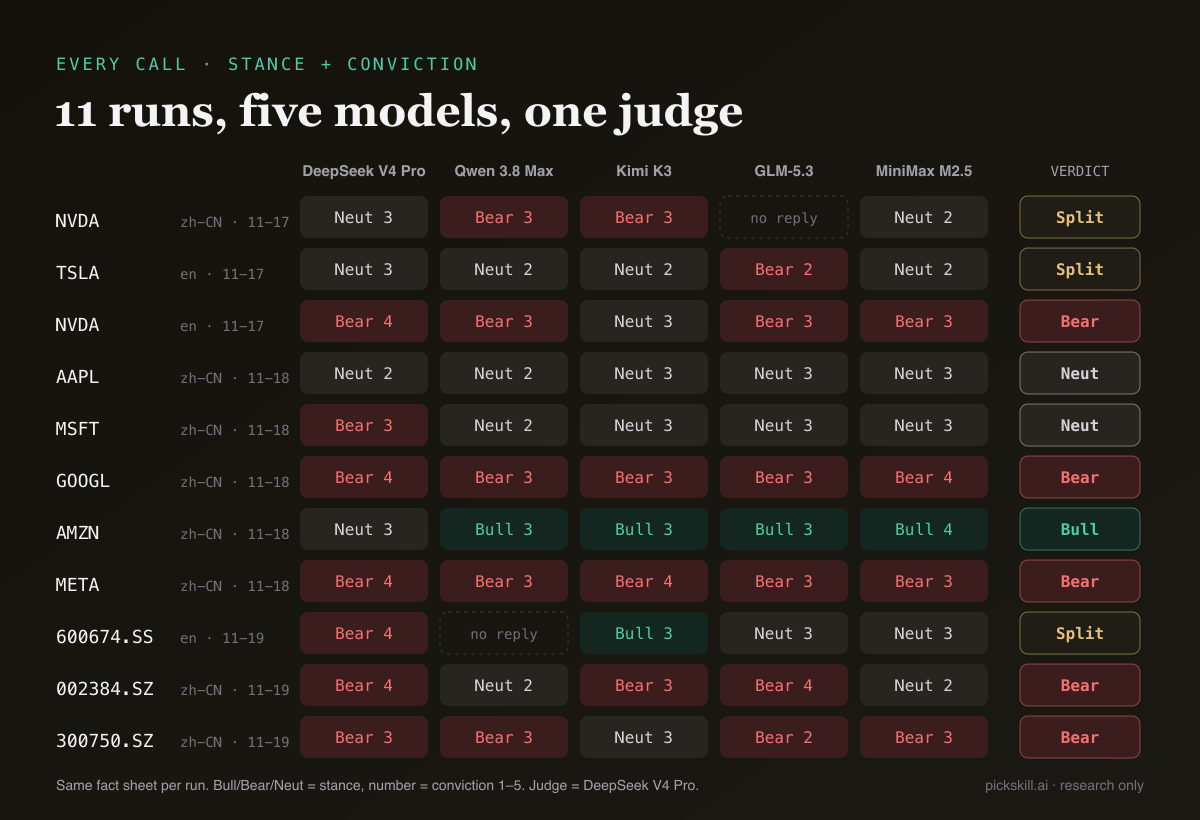
We compared five LLMs that sit on PickSkill's AI Panel: DeepSeek V4 Pro, Qwen 3.8 Max, Kimi K3, GLM-5.3 and MiniMax M2.5. In each run, every model receives the same JSON fact sheet for one stock: recent price action, eight technical signals (MACD, moving averages, RSI, KDJ, Bollinger Bands, ADX, volume, money flow) each with a 5-day trail, valuation ratios and the latest earnings. Each model returns a stance (bullish, bearish or neutral), a conviction from 1 to 5, a horizon, reasons, risks and a long-only strategy. DeepSeek V4 Pro then acts as judge: it reads all views and writes a verdict (bullish, bearish, neutral or split). Our sample is every saved run from 17–19 Nov 2026: NVDA twice, TSLA, AAPL, MSFT, GOOGL, AMZN, META and three China A-shares (600674.SS, 002384.SZ, 300750.SZ). That gives 55 possible views; 53 arrived.
Why do identical inputs matter for a fair comparison?
Identical inputs are the only way to attribute a difference in output to the model itself. If you ask DeepSeek, Qwen and Kimi about a stock in their own chat apps, each one may search the web differently, see prices from different days, receive different system prompts and read different news. A disagreement then tells you little: it could be the data, not the reasoning. On the panel, every model in a run gets the same fact sheet, the same instructions ("use only the facts provided, never invent numbers") and the same output schema, and all five are called in parallel at the same moment. Whatever varies after that, such as stance, conviction or chosen price levels, comes from the model. The test is fair but narrow: reasoning over structured data, not news reading or valuation work.
How did DeepSeek, Qwen and Kimi differ?
DeepSeek V4 Pro was the most decisive and the most bearish, Qwen 3.8 Max the most restrained, and Kimi K3 the most independent. DeepSeek never called a stock bullish; its 11 views split into 7 bearish and 4 neutral, with an average conviction of 3.36, the highest of the five. Qwen used conviction 2 in four views and 3 in six, never higher, for the lowest average (2.60). Kimi had the most bullish calls (2), sat at conviction 3 in 9 of 11 views, and was the lone dissenter twice: neutral on the English-language NVDA run and on 300750.SZ while the other four were bearish.
| Model | Views | Bullish / Neutral / Bearish | Avg conviction | Agreed with judge* | Lone dissenter | Median reply |
|---|---|---|---|---|---|---|
| DeepSeek V4 Pro | 11 / 11 | 0 / 4 / 7 | 3.36 | 6 / 8 | 2 | 56 s |
| Qwen 3.8 Max | 10 / 11 | 1 / 4 / 5 | 2.60 | 7 / 8 | 0 | 107 s |
| Kimi K3 | 11 / 11 | 2 / 5 / 4 | 3.00 | 6 / 8 | 2 | 50 s |
| GLM-5.3 | 10 / 11 | 1 / 3 / 6 | 2.90 | 8 / 8 | 1 | 58 s |
| MiniMax M2.5 | 11 / 11 | 1 / 6 / 4 | 2.91 | 7 / 8 | 0 | 10 s |
*Counted only in the 8 runs where the judge gave a direction; 3 runs were "split". Data: PickSkill AI Panel runs on 17–19 Nov 2026 data.
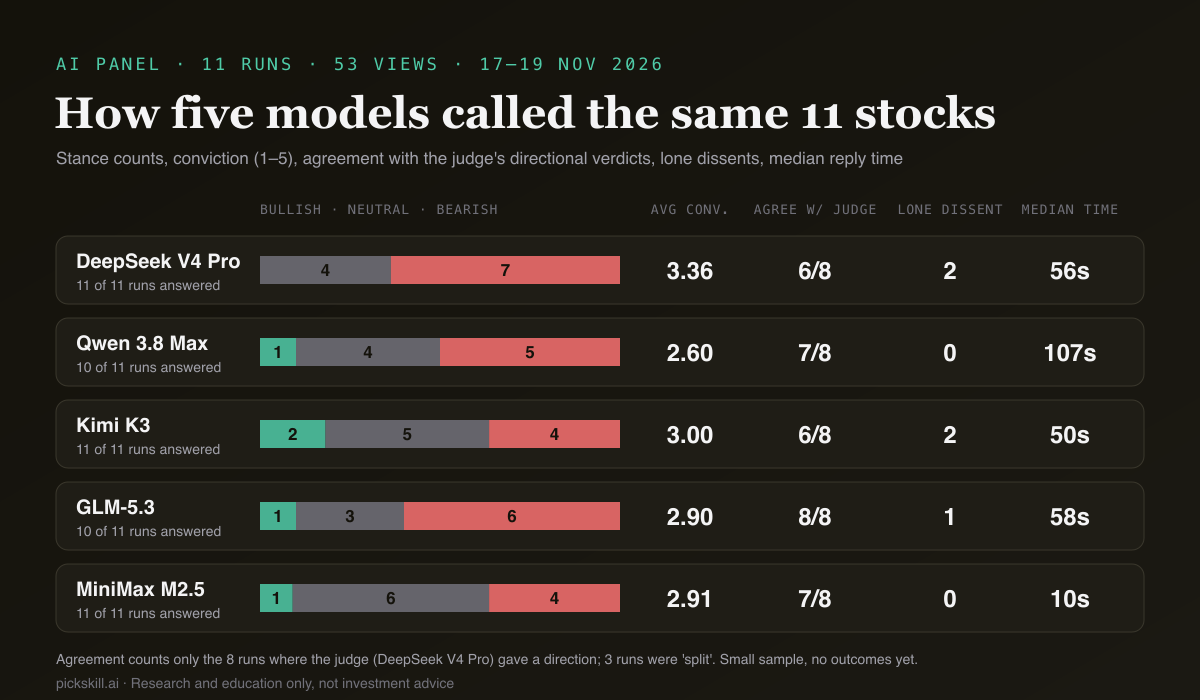
Two patterns stand out. First, the panel as a whole leaned bearish (26 bearish, 22 neutral, 5 bullish views), which mostly reflects the inputs: many of these stocks were falling, with NVDA down 7.95% over five days to 155.46 as of the 17 Nov close. Second, the horizon field told us nothing: all 53 views picked "weeks", because the prompt asks for a one-to-four-week view. For a full walk-through of one run, see five AI models analyse NVDA.
Which model disagreed with the others most often?
Kimi K3 and DeepSeek V4 Pro each broke from an otherwise unanimous panel twice, GLM-5.3 once, and Qwen 3.8 Max and MiniMax M2.5 never. We count a "lone dissent" only when every other model in the run shares one stance and this model holds a different one. DeepSeek's two dissents went in opposite directions: bearish on MSFT when the other four were neutral, and neutral on AMZN when the other four were bullish. GLM's single dissent was bearish on TSLA against four neutral views. The most divided run was 600674.SS (Sichuan Chuantou Energy), where Kimi was bullish, DeepSeek bearish and GLM and MiniMax neutral, and the judge returned "split". Only 3 of 11 runs were unanimous: AAPL (all neutral), GOOGL and META (all bearish).
A dissent is not an error; it often names a risk the majority skipped. Kimi's neutral NVDA call, for example, leaned on oversold readings (RSI near 22) while the others weighed the downtrend and money flow.
Is the judge biased towards DeepSeek?
It could be, and you should keep that in mind when reading the "agreed with judge" column. The judge is DeepSeek V4 Pro, the same model as one panellist. Research on LLM-as-a-judge setups has documented a "self-enhancement" bias, where a model favours answers like its own (Zheng et al., 2023). In our 11 runs the effect is not visible: DeepSeek's own stance matched the verdict 6 times out of 8, the joint-lowest rate, while GLM-5.3 matched 8 out of 8. On MSFT the judge sided with the four neutral views over DeepSeek's bearish one, and on AMZN with the four bullish views over DeepSeek's neutral one. The judge also sees the vote tally, so "agreement with the judge" partly measures agreement with the majority.
Does the same model give the same answer twice?
Not reliably. NVDA ran twice on the same fact sheet (17 Nov close, 155.46), once with output in Chinese and once in English. Of the four models that answered both times, three changed stance: DeepSeek went from neutral (3) to bearish (4), Kimi from bearish (3) to neutral (3), and MiniMax from neutral (2) to bearish (3). Only Qwen held bearish at conviction 3 both times. The judge moved from "split" to "bearish". We cannot tell whether the output language or ordinary sampling randomness caused the shift, with one pair it could be either. Either way, one answer from one model is a sample, not a measurement.
How can you compare AI models for stock analysis yourself?
You can reproduce this comparison with any set of model outputs, as long as the inputs were identical. Here is the method we used:
- Fix the input. Give every model the same dated data (one fact sheet per stock), the same instructions and the same output schema.
- Collect structured outputs. Require a stance, a 1–5 conviction and a horizon as fields, so you can count them rather than interpret prose.
- Log failures. Record which model failed to answer and why (here: one timeout, one missing reply). Missing data is a behaviour too.
- Count, don't grade. Tally stances, average conviction, agreement with the final verdict and lone dissents per model.
- Wait for outcomes before ranking. Accuracy needs prices after the horizon ends, ideally across many runs and market regimes.
The core of our script, run against the exported runs:
for run in runs:
    views, verdict = run["result"]["views"], run["result"]["summary"]["verdict"]
    for m in MODELS:
        if m not in views:
            missing[m].append(run["ticker"]); continue
        v = views[m]
        stance[m][v["stance"]] += 1; conviction[m].append(v["conviction"])
        if verdict != "split":
            judged[m] += 1; agree[m] += v["stance"] == verdict
        others = {views[o]["stance"] for o in views if o != m}
        if len(views) >= 3 and len(others) == 1 and v["stance"] not in others:
            lone[m] += 1
So which AI model is best for stock analysis?
Based on 11 runs, the honest answer is that it depends on what you want from the model, and accuracy is still unknown. If you want a decisive read with clear levels, DeepSeek V4 Pro committed hardest. If you want a cautious second opinion, Qwen 3.8 Max rarely went above conviction 3, though it was the slowest and timed out once. Kimi K3 is the one most likely to challenge a consensus. GLM-5.3 sat closest to the final verdict, and MiniMax M2.5 was by far the fastest. The spread between them is the useful signal, which is why the PickSkill AI Panel shows all five views side by side with the judge's agreements and disagreements. For how this fits a wider workflow, see our guide to AI for stock research in 2026.
We will repeat this once enough runs have passed their horizon to score against prices. Research and education only, not investment advice.
FAQ
Is DeepSeek better than Qwen for stock analysis? In our 11 runs on 17–19 Nov 2026 data, DeepSeek V4 Pro was more decisive (average conviction 3.36 vs 2.60) and more bearish than Qwen 3.8 Max, but no outcomes exist yet to judge which was more accurate. "Better" depends on whether you want a firm view or a cautious one, and on accuracy data that will take weeks to collect.
Which LLM is best at analysing stocks? No LLM has been shown to be reliably best on our data yet. With identical inputs, the five models we tested differed mainly in conviction, how often they dissented, reliability and speed. Comparing several models on the same fact sheet and reading where they agree is more informative than trusting one model's answer.
Why does the same AI model give different answers on the same stock? Language models sample their output, so the same input can produce a different stance on another run. In our data, NVDA was analysed twice on identical figures and three of four models changed stance between runs. Treat any single AI answer as one sample and look for agreement across models or runs.
How does the PickSkill AI Panel choose the final verdict? DeepSeek V4 Pro acts as judge. It reads all five analysts' views and the conviction-weighted vote, then writes a verdict (bullish, bearish, neutral or split), the main agreements and disagreements, a long-only strategy and what to watch next. Free accounts get one AI Panel run a month; a stock someone already analysed that day loads free.
Can I see the full analyses behind these statistics? Yes. The NVDA run is written up in our post on five AI models analysing NVDA. You can also run the panel yourself on US, Hong Kong, China A-share, Japanese and Korean stocks from the AI Panel page after signing in, and see every model's reasons, risks and price levels.