ChatGPT for Stock Analysis: What Works, What Breaks
An honest guide to ChatGPT for stock analysis: what it does well, where numbers go wrong, how to fix each gap, and 6 copy-paste prompts.

ChatGPT can help you analyse a stock, but it is a reasoning tool, not a data source. ChatGPT for stock analysis is using a general chatbot to explain concepts, structure an investment thesis, summarise filings and write analysis code, while you supply or verify the numbers. OpenAI's own help page on web search, checked on 19 November 2026, warns that search results and citations "can be incomplete, outdated, or incorrect".
That is the whole game: use the model for thinking, and feed it data you can check. This guide covers what ChatGPT does well, where it breaks, a fix for each gap, and six prompts you can paste today.
Key takeaways
- Strong at language work: explaining indicators and ratios, turning a hunch into a testable thesis, summarising a 10-K you paste in, and writing Python for a backtest.
- Weak at numbers it has to remember: prices, margins and dates from training data can be stale or simply invented. Web search helps, but OpenAI says its results can be wrong.
- Live data needs a tool: search, connected apps or an MCP server. As of November 2026, full custom MCP is a Business, Enterprise and Edu feature; Pro users can connect custom MCP servers with read/fetch permissions.
- Answers drift run to run: the same prompt can return a different stance. Ask several times, or ask several models, and read where they disagree.
- Verify every figure against the filing on SEC EDGAR or the company's investor-relations page before it touches a decision.
Can ChatGPT analyze stocks?
Yes, within limits. ChatGPT can reason about a business, read the documents you give it, and explain what an indicator means, which covers a large share of the work in researching a new stock. What it cannot do on its own is know today's price, last night's earnings or your actual holdings. Those come from outside the model: web search, a connected app, a file you upload, or a data tool exposed over the Model Context Protocol (MCP). Without one of those, any number ChatGPT gives you is recalled from training data and may be months out of date or wrong. Let ChatGPT do the reading, structuring and arguing; let a source you can cite supply the numbers. For a wider view of the tool landscape, see our AI for stock research in 2026 overview.
What is ChatGPT good at in stock research?
ChatGPT is best at the language-heavy parts of research: explaining, structuring, summarising and coding. These tasks reward fluent reasoning and do not depend on the model remembering an exact number. Paste the risk-factor section of an annual report and ask for the five risks that changed since last year, and it does in a minute what takes an hour by hand. It is also a capable coding partner: it can write pandas code to compute RSI or a moving-average crossover on a CSV you provide, which is far more reliable than asking it to "tell you" the RSI.
Four jobs where it earns its keep:
- Explaining concepts: what MACD, the P/E ratio or WACC measures, and when each misleads.
- Structuring a thesis: turning "I like this company" into claims, evidence and the facts that would prove you wrong.
- Summarising documents you supply: 10-Ks, earnings-call transcripts, proxy statements. Our 10-K in 60 seconds walkthrough shows the workflow.
- Writing analysis code: screens, charts and simple backtests you can run and inspect yourself.
What can ChatGPT do with live market data in November 2026?
ChatGPT now has several routes to current information, but each has limits, and none turns it into a terminal. We checked OpenAI's help centre on 19 November 2026. Web search is available on Free, Go, Plus, Pro, Business, Enterprise and Edu, and ChatGPT may search automatically when a question needs current information. Finances in ChatGPT lets US users on Free, Go, Plus and Pro connect accounts through Plaid and see a market-update widget for their equity holdings; OpenAI states it cannot make trades and that ChatGPT "is not a fiduciary, registered investment adviser, broker-dealer". Custom MCP servers with full support are available to Business and Enterprise/Edu workspaces on the web, while Pro users can connect them with read/fetch permissions. A separate ChatGPT for Financial Services plan for financial institutions includes US equity pricing delayed by 15 minutes.
Where does ChatGPT fail at stock analysis?
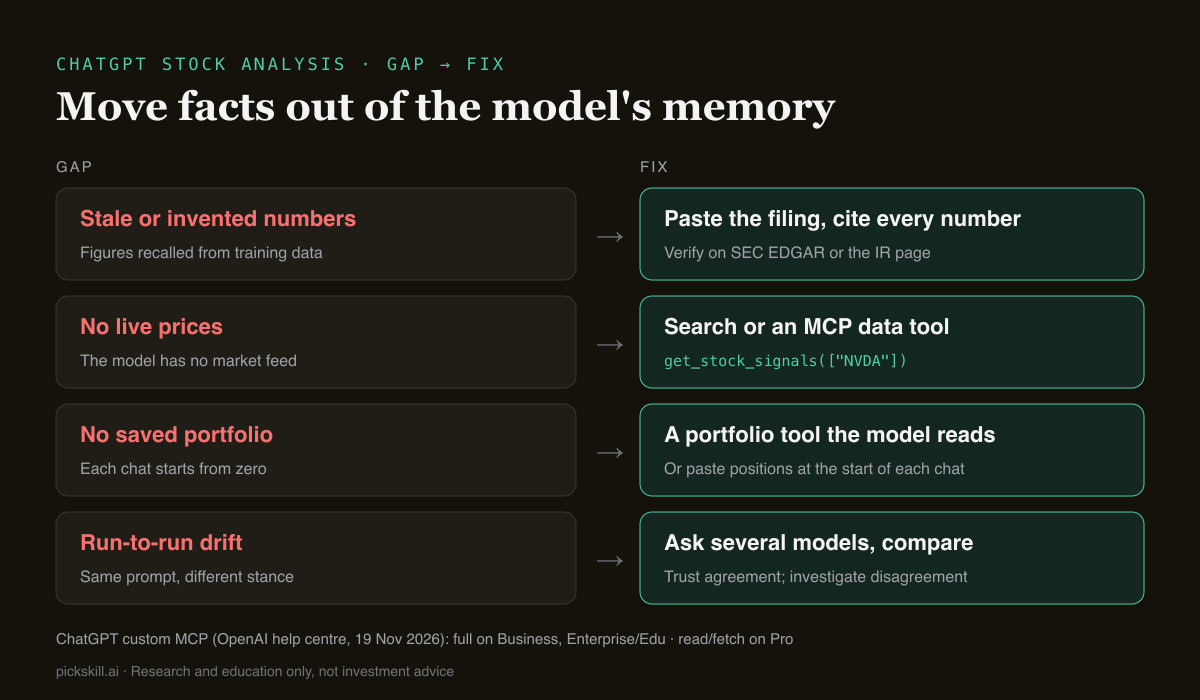
ChatGPT fails in four predictable places, and all four come from the same root: a language model generates plausible text, and plausible is not the same as correct. These follow from how chatbots work, so the fix is in how you use them.
- Stale or hallucinated numbers. Without a tool call, revenue, margins, share counts and dates come from training data. The model will often state them confidently, with no sign that they are years old or made up.
- No live prices unless a tool runs. Even with search on, a quote may come from a cached article. Check which source and timestamp a figure came from.
- No persistent portfolio view. A normal chat does not know what you hold or what it told you last week. The Finances feature is US-only and focused on accounts, budgets and holdings, not signal-level analysis.
- Inconsistent run to run. Ask the same question twice and you can get a different stance. When we ran the same NVDA fact sheet (17 Nov 2026 close) through our five-model AI Panel twice on 19 November, the verdict moved from split to bearish; we break that down in Can AI pick stocks?.
How do you fix each gap?
Each weakness has a practical fix, and most cost nothing but a habit. The pattern is the same throughout: move facts out of the model's memory and into a source it reads during the conversation, then make it show you where each number came from.
| Gap | Why it happens | Fix |
|---|---|---|
| Stale or invented numbers | Figures recalled from training data | Paste the filing or upload the PDF; ask it to quote the page or section for every number |
| No live prices | The model has no market feed | Turn on search and check the cited source and timestamp, or connect a data tool via MCP |
| No portfolio context | Each chat starts from zero | Use a portfolio tool that exposes holdings to the model, or paste your positions each time |
| Run-to-run drift | Sampling makes outputs vary | Ask 2–3 times or ask several models; trust only what they agree on, and investigate disagreements |
| Confident but unsourced claims | Fluent text sounds authoritative | Require citations; verify against SEC EDGAR or the company's IR page |
If you want the data step automated, a stock-data MCP server is the cleanest route: the model calls a tool such as get_stock_signals and answers from the returned numbers, not from memory. Setup differs by client; our guide to connecting Claude and ChatGPT to stock signals walks through it.
What are the best ChatGPT prompts for stock analysis?
The best prompts give ChatGPT a role, the source material, and an output format, and they forbid it from filling gaps with remembered numbers. The six below work in ChatGPT, Claude or any capable chatbot; replace the bracketed parts and paste your data or filing after the prompt.
- Thesis check: "Here is my thesis on [TICKER]: [2–3 sentences]. List the three claims it depends on, the evidence for and against each, and the single fact that would prove me wrong. Use only the data I paste below; write 'not provided' where data is missing."
- 10-K summary: "Summarise this 10-K for a retail investor in under 300 words: business model, revenue drivers, the three biggest risk factors and anything new versus last year. Cite the section for each point. Do not add numbers that are not in the text."
- Peer comparison: "Compare [TICKER] with [PEER 1] and [PEER 2] in a table: revenue growth, gross margin, operating margin, P/E and net debt, using only the figures I paste below. Then explain in 100 words what the table says and what it cannot tell us."
- Risk pre-mortem: "Assume it is one year from now and [TICKER] has fallen 40%. Write the five most plausible reasons, ranked by likelihood, and for each name an early warning sign I could monitor in filings or price data."
- Indicator explanation: "Explain what these readings mean together for [TICKER]: [e.g. RSI 28, MACD below signal, price under the 200-day MA]. Say where the signals agree, where they conflict, and what would confirm or cancel each one. No buy or sell call."
- Answer audit: "Review your previous answer. List every number you used, where it came from (my data, search result or memory), and mark any figure from memory as unverified."
The last prompt is the cheapest safeguard in this list. Run it after any answer that includes numbers. For more on reading indicator combinations, see MACD vs RSI.
How does PickSkill fit with ChatGPT?
PickSkill is built around the gaps above rather than around the chatbot. Our AI analyst answers questions on US, Hong Kong and China A-share stocks from live prices, fundamentals and filings, with sources shown. The AI Panel puts five models on the same fact sheet and reports where they agree and disagree, which addresses run-to-run drift directly. If you prefer your own assistant, the PickSkill MCP server exposes signals, portfolios, earnings highlights and screens as tools, billed in prepaid credits (1 credit for a signals call, 3 for a screen).
Research and education only, not investment advice.
FAQ
Can ChatGPT give real-time stock prices? Not from the model itself. ChatGPT only sees current prices when a tool supplies them, such as web search, a connected app or an MCP data server. Even then, check the cited source and its timestamp, because OpenAI notes that search results can be incomplete or outdated. For trading-grade quotes, use your broker or an exchange feed.
Is ChatGPT accurate for stock analysis? It is accurate at explaining concepts and summarising text you give it, and unreliable at recalling figures from memory. Numbers such as revenue, margins or share counts can be stale or invented if no source is supplied. Paste the filing, ask for citations and verify key figures on SEC EDGAR or the company's investor-relations site before relying on them.
What is the best prompt for stock analysis in ChatGPT? A good prompt names the task, supplies the data and sets the format, for example: "Using only the 10-K text below, summarise the business, the three biggest risks and what changed from last year, citing the section for each point." Ending with "write 'not provided' where data is missing" stops the model from filling gaps with guesses.
Why does ChatGPT give different answers to the same stock question? Language models sample their output, so identical prompts can produce different wording and sometimes a different conclusion. Small changes in phrasing, language or the data provided widen the spread. Ask two or three times, or compare several models, and treat only the points they agree on as a signal worth investigating further.
Can I connect ChatGPT to my own stock data? Yes, through connected apps or custom MCP servers. According to OpenAI's help centre (checked 19 November 2026), full custom MCP support is available to Business and Enterprise/Edu workspaces on ChatGPT web, and Pro users can connect custom MCP servers with read/fetch permissions. Claude, Cursor and VS Code also support MCP servers.